
Coming soon · Nonfiction

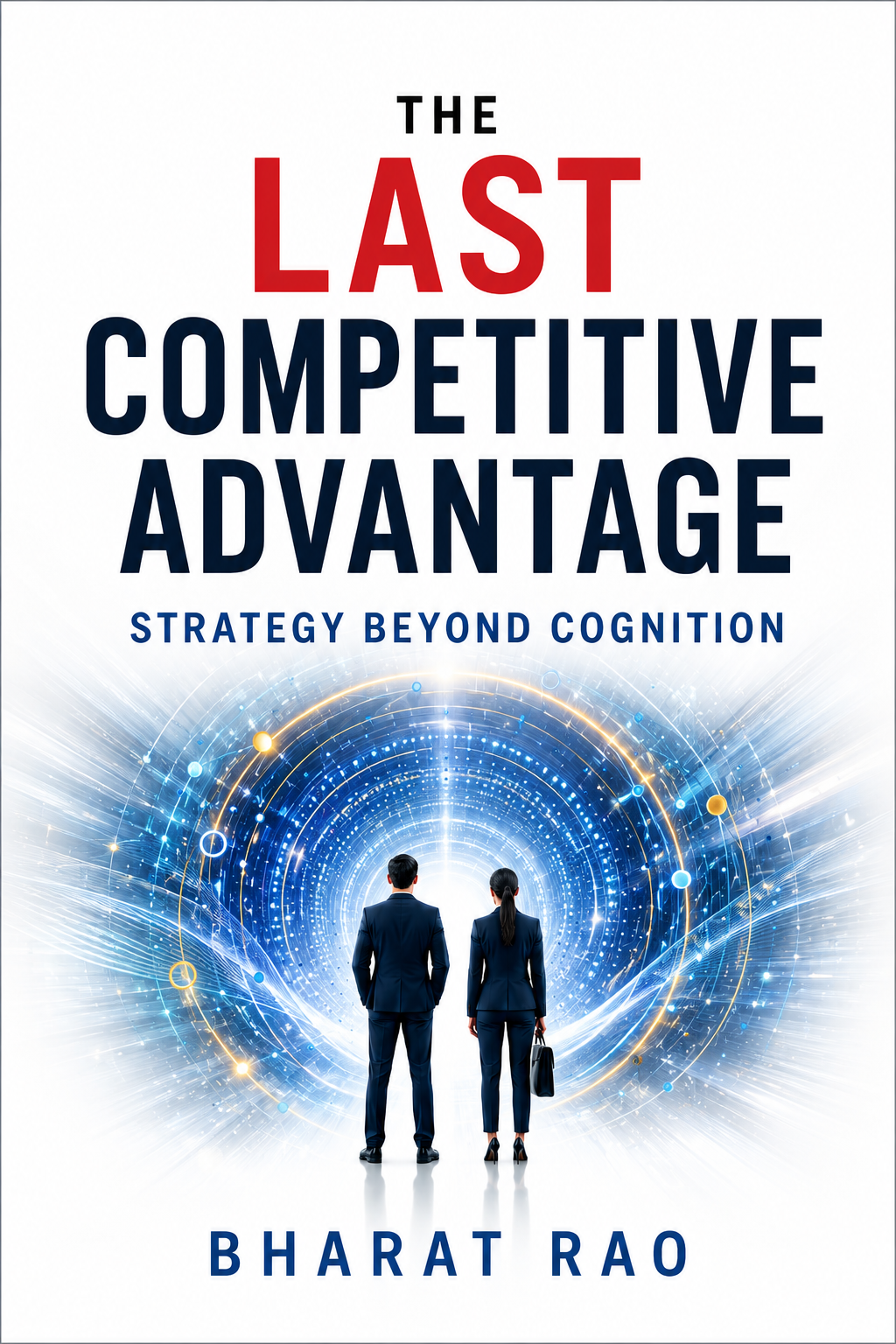
The Last Competitive Advantage

Strategy Beyond Cognition

Every civilization organizes itself around a scarcity. The industrial era organized around scarce labor. The information era organized around scarce knowledge. The era now opening organizes around the abundance of intelligence itself. The Last Competitive Advantage argues that once machine cognition becomes cheap, scalable, and ambient, scarcity does not disappear. It migrates upward, into the capacities that resist computation.

“The argument is not that humans win. The argument is that the terrain of advantage changes.”

The Last Competitive Advantage: Strategy Beyond Cognition, by Bharat Rao, published by Core Loop Press

Scarcity does not vanish when intelligence becomes abundant. It moves.

The book's central concept is scarcity migration: as a previously scarce resource becomes abundant through technology, differentiation moves to the next adjacent layer of capability that resists computation. Named against it is the Cognitive Scarcity Regime, the two-century-old institutional arrangement built around the assumption that intelligence itself is scarce: credentialism, professional gatekeeping, expertise treated as status, and analysis conducted without accountability for the outcome.

  • Judgment, the capacity a court still refuses to hand to a machine even when the machine is allowed to inform the decision.
  • Taste, the trained, accountable point of view that survives a tool capable of generating any image at all.
  • Trust, named directly by industry analysts as the new organizational scarcity once expertise itself can be generated on demand.
  • Agency, the willingness to act and answer for the outcome, examined against the ordinary experience of surrendering a decision to an app.

The scarcity migration argument, tested against real cases.

The accountability boundary

In State v. Loomis, the Wisconsin Supreme Court permitted judges to consider an algorithmic risk score at sentencing but explicitly barred it from determining incarceration or sentence length. The Last Competitive Advantage reads the ruling as a boundary the legal system has already drawn around judgment, not a hypothetical one.

Taste, steelmanned and then distinguished

Refik Anadol's Unsupervised ran at MoMA from November 2022 to October 2023, trained on the museum's own collection, drew more than three million visitors, and was later accessioned into MoMA's permanent collection. The book takes the strongest AI-art case seriously before distinguishing the model's generation from the human and institutional taste that selected, trained, and exhibited it.

Trust, named by name

Gartner's May 2026 research named trust directly as the new organizational scarcity, the resource an enterprise runs short of once expertise itself can be generated rather than earned. The Last Competitive Advantage treats that as confirmation from an unlikely source, an industry analyst firm making the same argument as the book.

When judgment fails on its own

Long-Term Capital Management and the Boeing 737 MAX both appear as counter-cases: organizations where the failure was not a lack of intelligence or data, but a failure of the specifically human capacity the book calls judgment. The Last Competitive Advantage does not romanticize the human side of the ledger.

The convenience question

At what point does convenience become surrender. The book opens its account of agency with the ordinary experience of handing a decision to a phone, then follows the same logic into cognitive offloading and the atrophy of the executive function that used to make the decision in the first place.

Intelligence as infrastructure, confirmed

OpenAI's own April 2026 Right to AI position treated intelligence itself as infrastructure, the same claim The Last Competitive Advantage makes as its opening premise. The book uses the industry's own language as evidence rather than as something to argue against.

Bharat Rao

An educator, researcher, and writer, and the author of several papers, books, and reports on technology innovation.

Author profile