03Career About 3 minutes
What protects your work from AI?
Look beyond a job title: explore its published tasks, reflect on where your time goes and test an explicit time-saving assumption. Published AI ratings provide context; your scenario is hypothetical and does not predict jobs or pay.
Build a task portfolio
Choose from 756 occupations. Start with equal time across all listed tasks, then adjust relative weights to reflect your week. A weight of 2 gets twice as much time as 1; zero removes a task from your scenario. These are historical task descriptions, not a complete account of your work.
Loading the published task set…
Published reference ratings and observed Claude activity use different methods and dates. They are not a gap to close. Your time-weighted rating below is a separate calculation using your assumptions.
Adjust task weights
All weights normalize to 100% of your week. Equal weights are a starting assumption, not measured time use. At least one task must have positive weight. The task-level activity measure describes the source dataset, not your use.
Your illustrative scenario
Largest scenario contributions to review
These are prompts to examine your workflow, not recommendations to automate a task. Check quality, accountability, safety and permission before using any AI system. No protected-hours estimate or employment prediction is made.
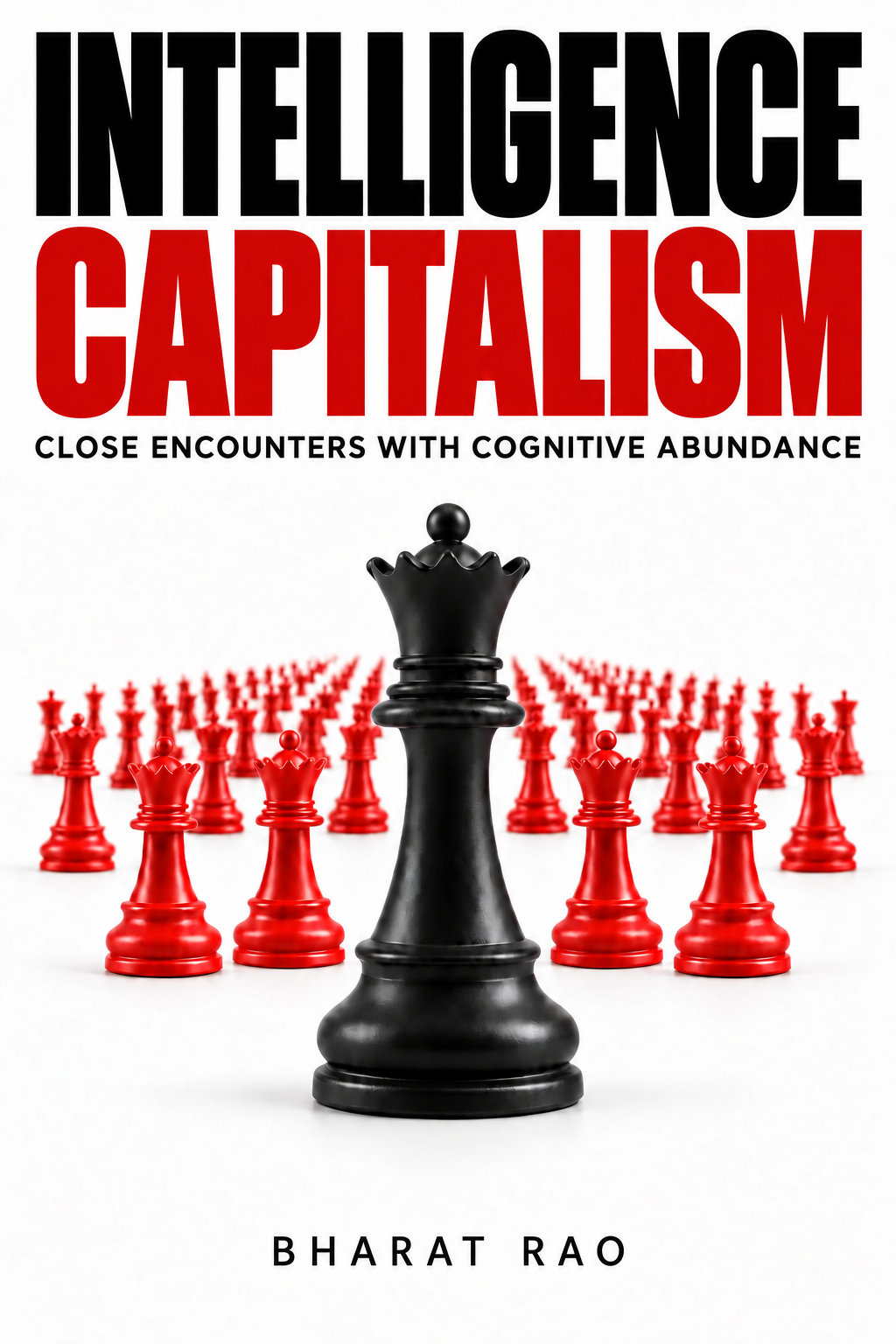
Which work keeps its value as intelligence gets cheaper is a central question in Intelligence Capitalism by Bharat Rao.
Sources, methods and limits
Full coverage, with a crosswalk. This edition includes 16,644 distinct task statements across all 756 occupations used in Tool 04. We select the general O*NET .00 occupation where present; otherwise we combine specialties within the six-digit SOC (23 groups). Fifteen duplicate statements with identical ratings are collapsed, retaining source IDs. Nothing is imputed. Historical task lists may omit work you actually do.
Task ratings. Eloundou et al., GPTs are GPTs (2023), pinned source supplies GPT-4 labels: E0 = 0, E1 = 1, E2 = 0.5. These concern whether tasks could be completed faster at similar quality, including additional software for E2; they are not probabilities of job loss or direct estimates of saved hours. The published occupation reference gives Core tasks twice the weight of others and averages specialty references where no general occupation exists. Your rating instead uses your normalized time weights.
Observed activity. Anthropic Economic Index, pinned data and the March 2026 report use August and November 2025 Claude usage. All selected task statements match exactly. Task penetration is shown individually; we do not average it into a personal score. The published occupation score has its own time and automation weighting and describes one AI system, not all workplace AI.
Scenario formula. Time-weighted rating = sum of (normalized task weight × GPT-4 task rating). Illustrative freed hours = weekly hours × that rating × your assumed saving fraction. The saving fraction is your hypothetical input, not measured productivity. It intentionally treats ratings as scenario coefficients; it is not an empirical hours estimate. All tasks share the same assumed fraction. Hours remain between zero and your stated week. This exercise does not model adoption costs, new work, quality review, regulation or demand. It cannot predict pay, jobs or displacement.
Attribution and licensing. Task statements contain information from the O*NET 27.1 Database, U.S. Department of Labor, Employment and Training Administration, used under CC BY 4.0; Core Loop Press selected, grouped and deduplicated them. See the O*NET license. OpenAI source code/data is MIT licensed; Anthropic's dataset card specifies CC-BY for data and MIT for code. Source revisions, hashes, IDs and the full MIT notice are included in the downloadable task dataset.
Privacy. Your weights, hours and saving assumption stay in this browser. An existing anonymous completion count records no answers. Sharing requires review: the PNG includes your scenario; the link includes only the occupation and opens default assumptions. Optional email signup sends only the existing contact and consent fields, as described in the privacy notice. This is an educational exercise, not career advice.